


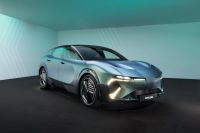
17 Apr Renault Emblème a demo car that achieves 70% reduction in its carbon footprint
London, April 17, 2025, (Oilandgaspress) –––– Renault Emblème is an invitation to travel with a cabin of contemporary, poetic design. Innovative technologies include a new wide openR panorama screen spanning the length of the dashboard.
The dual-energy electric powertrain under the rear floor is powered by electricity and hydrogen, an ideal combination for more low-carbon journeys over both short and long distances.
Renault Group is positioning itself as a key player in low-carbon mobility. Following the Paris Climate Agreement in 2015, the Group adapted its strategy in order to reduce the greenhouse gas (GHG) emissions of its activities and contribute to maintaining the global temperature increase well below 2°C.
Contributing to the goal of carbon neutrality, Renault Group is seeking to achieve net zero globally by 2050 and by 2040 for operations in Europe. This ambition is supported in particular by Ampere, the Group entity dedicated to intelligent electric vehicles. Renault Emblème is at the forefront of this revolution!
A collaborative project involving the automotive ecosystem
More than twenty partners, all experts in their own fields, worked on the project with Renault and Ampere. Each one brought their own technology or know-how to the table as part of the drive to optimise decarbonisation, with no trade-off in value or quality. To achieve the highest possible level of decarbonisation, each partner implemented their own innovations at their own level in pursuit of the most appropriate energy efficiency solutions involving the use of low-carbon energy as part of a circular economy approach:
Door handles – AKWEL
The “sensitive” door handles were designed under an eco-design approach. Extremely favorable for aerodynamics, their optimized design has reduced the overall weight of the finished part by 60%. The simplification of the mechanism has resulted in a reduction of 50 components, while still providing an opening activation response of 0.1 seconds.
Body parts – ArcelorMittal
Using advanced high strength steels (AHSS) and press hardenable steels (PHS), ArcelorMittal reduced the weight of the steel required for the body-in-white by 8%, for greater energy efficiency and decarbonisation. The XCarb® Recycled and Renewably Produced steels in the B-pillar
Single-material thermal and acoustic insulation – Autoneum
Autoneum designed 32 parts for Emblème with thermal and/or acoustic properties, both inside and outside the vehicle.
Alloy wheels – Dicastal
The Renault Emblem rims have been designed with eco-design in mind, with a design close to the solid wheel, particularly conducive to aerodynamics.
Tyres – Michelin
Tyres play a crucial role in low-carbon vehicle projects, since they account for around 20% of vehicle energy consumption.
Hydrogen tank – OPMobility
To reduce the vehicle’s weight and carbon footprint, the hydrogen tank is made from carbon fibre using low-carbon energy.
Interior – Forvia
For the vehicle interior, particularly the dashboard, Forvia selected coverings based on recycled or natural materials (linen, pineapple), which also have the advantage of being carbon sinks, i.e. capable of storing CO₂.
Information Source: Read More
Oil and gas press covers, Energy Monitor, Climate, Gas,Renewable, Oil and Gas, Wind, Biomass, Sustainability, Oil Price, LPG, Solar, Marine, Aviation, Fuel, Hydrogen, Electric ,EV, Gas,
Sorry, the comment form is closed at this time.