


21 May Global jet fuel supply analysis
(Oilandgaspress) -–Countries in the Persian Gulf play two important roles in global jet fuel supply: They export a significant share of the world’s jet fuel and supply crude oil to refineries — particularly in Asia — that produce and export jet fuel globally.
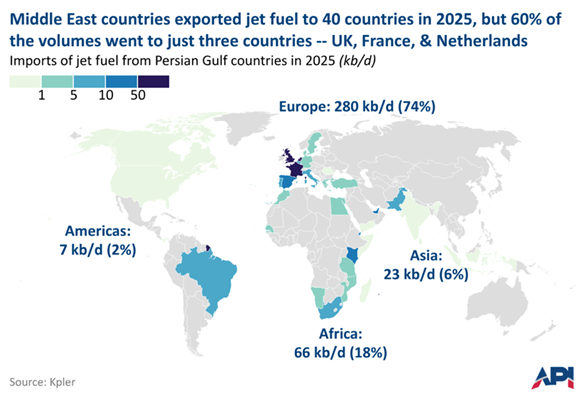
Before the conflict, refineries in the Persian Gulf produced and exported roughly 20% of the world’s seaborne jet fuel — about twice the share of seaborne diesel. When the Strait of Hormuz was disrupted, those exports all but stopped. Most of those jet fuel exports were destined for Europe, which is why supply there has been more acutely impacted.
About 40% to 60% of the crude oil that refineries in China, South Korea, and India imported and processed into jet fuel and then exported to other markets transited the Strait of Hormuz. Without crude oil from the Persian Gulf, those Asian refineries have cut runs and reduced their own exports, including jet fuel.
Refineries process crude oil into a range of products — the big three are gasoline, which most of us put into our cars, motorcycles and small boats; diesel, which powers trucking, trains, ships and more; and jet fuel, which fuels jet aircraft and helicopters. But only about 11% of each barrel becomes jet fuel, and it’s generally difficult to increase that share. In the U.S., refineries have only been able to increase jet fuel production by roughly 2-4%.
California and other Pacific states rely on imports for about 20% of their jet fuel, mostly from South Korea, whose refineries depend on Middle Eastern crude. Strong domestic production improves resilience — but in a connected global market, it can’t fully shield American consumers from a crisis halfway around the world.
Information Source: Read More
Sorry, the comment form is closed at this time.